
What Cursor is really selling: the future of AI coding tools
A year ago, the most talked-about tool in software was a code editor. It looked like the editor most developers already used, with one difference: you could ask it to write the code for you, and it would.
In August, that editor became part of a rocket company.
Cursor, made by a startup called Anysphere, was acquired by SpaceX and now sits alongside the Grok models. The price was reported at 3 billion.
It is a remarkable business story. It is also the clearest map we have of where the value in building software is moving, and it is not where most founders think.
What is Cursor really selling?
The short answer: Cursor started by selling a faster way to write code. Writing code is now the cheapest part of building software, and every large AI lab sells it. So Cursor has moved into everything around it: its own models, agents that run in parallel, review and rollout. What none of these tools sell is the decision about what to build.
That decision is the work we do at Speed Systems, where we build products for founders. This piece is about why it has become the scarce part, using the company that did the most to make everything else plentiful.
How has Cursor's pitch changed?
Follow what Cursor said about itself and you can watch the value move.
In 2023 it was "the AI-first code editor": the familiar tool, made smarter. In October 2025, Cursor 2.0 put agents at the centre and shipped Composer, its first model of its own. In April 2026, Cursor 3 described fleets of agents working on their own. Today the homepage calls it a "coding agent for building ambitious software", and the pricing page leads with generous limits for Grok.
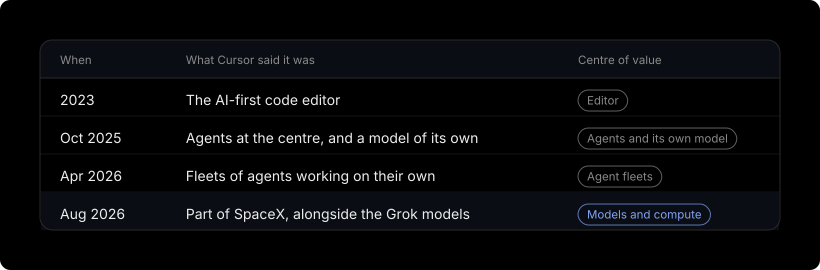
Each step answers the same pressure. Once anyone can generate code, the editor stops being the product. The product becomes whatever is still hard.
Why does a coding tool need its own models?
Because for most of its life, Cursor's engine belonged to someone else.
The best coding models come from a handful of labs, and those labs now sell their own coding agents. Anthropic has Claude Code. OpenAI has Codex. A tool built on their models is renting its engine from a competitor, and a landlord can end the lease. In June 2025 Anthropic cut a rival editor, Windsurf, off from its models during acquisition talks. On 29 August this year, OpenAI said it would stop supplying models to Cursor from 12 November. Cursor's co-founder said OpenAI models were about 5% of its traffic, which tells you how far it had already moved.
That move had not been smooth. In March, Cursor's second in-house model, Composer 2, turned out to be built on an open-source Chinese model, Moonshot's Kimi, which Cursor had not mentioned at launch. Its co-founder called the omission "a miss". Owning your engine turns out to be hard, even with billions in revenue.
Then there is the bill. Agents that work on their own for longer use far more computing, so pricing has followed usage. Cursor moved to usage-based pricing in mid-2025 and apologised for how it communicated the change. Today every plan has an allowance, with anything beyond it "billed in arrears". GitHub moved Copilot to usage-based credits in June 2026, saying agentic use is becoming the default.
The lesson for anyone building a product, not only a coding tool: if your product sits on someone else's engine, plan for the day the engine's owner becomes your competitor.
Does AI coding actually make teams faster?
Less clearly than the revenue suggests.
The best controlled study, by the research group METR in July 2025, found experienced developers took 19% longer on tasks in their own projects with AI, while believing it had made them 20% faster. The study was small and the tools were early-2025 tools. A 2026 follow-up pointed the other way, towards a speed-up, but its authors call it weak evidence, partly because developers would no longer agree to work without AI.
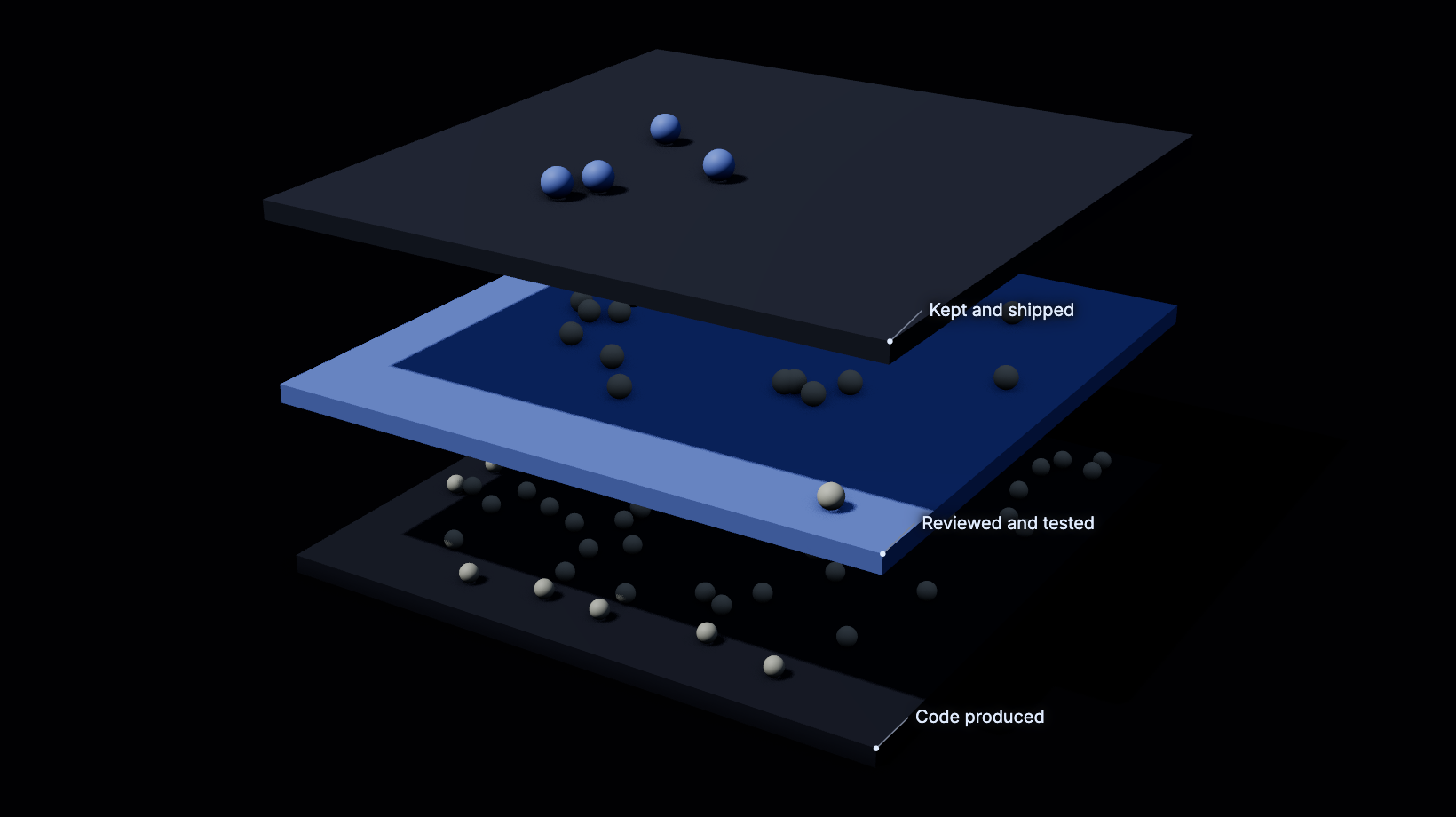
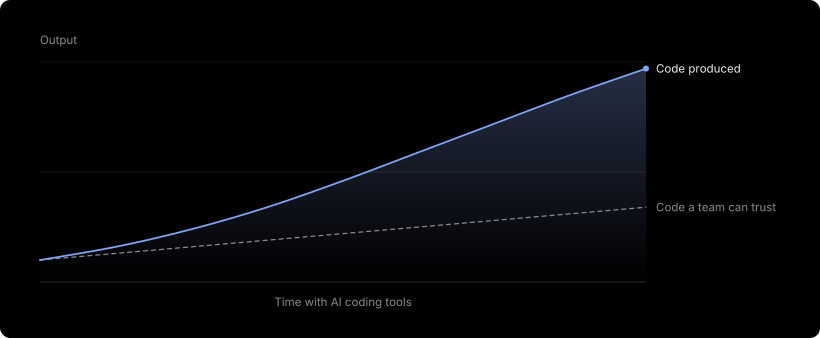
The larger signal comes from Google's DORA research, which surveys software teams every year. Its latest findings say more AI adoption now goes with more delivery throughput and more instability, at the same time. Teams ship more, and more of it breaks. The time saved writing code moves to checking it. As one engineer in that research put it, reviewing someone else's code is much harder than writing it.
That is the pattern underneath the whole category. Generating code got cheap. Trusting code did not.
Where are AI coding tools going next?
Downstream, step by step, following the bottleneck.
Every serious player now ships the same three things: an editor, a command-line tool and agents that run in the cloud. Writing code is table stakes, so the race has moved to what happens after. Cursor's recent moves read like a walk down the production line: Bugbot for code review, an agreed purchase of the review tool Graphite, Firetiger for agents that watch software in production, and in September, bots for rollouts and security review. Each one chases the work that piles up once code is free.
Follow that line to its end and you find the one step none of these tools can take. They can write, check, ship and watch. They cannot decide what is worth building, for whom, and what to leave out. That decision sits upstream of every tool in the race.
The tools are racing to own every step after the decision. None of them can own the decision.
What does this mean for a founder?
If you are about to build a product, the tool question matters less than it feels.
Pick tools loosely. Whatever is best this quarter may be owned by someone else next quarter, and lose access to the model it relied on. Keep your code in your own repository and your accounts in your own name, so nothing about your product depends on one editor.
Spend your attention upstream. The expensive mistakes in a first version are not typing mistakes. They are building the wrong thing, or too much of it. That is a decision about scope and customers, and it is where we start every build at Speed Systems.
Budget for checking, not just making. If code arrives faster than anyone can review it, you have not saved time; you have moved it. Ask whoever builds your product how the code is reviewed, tested and owned after launch.
Measure what ships and stays. The number that matters is not how much code was written. It is how much of the product works, is used, and is still there in three months.
At Speed Systems the tool is the least interesting decision in a build. What we are hired for is the part that does not move downstream: working out what to build, and making sure what comes back is right.
Questions founders ask about AI coding tools
Is Cursor worth it for a startup?
For a team that writes code every day, an AI editor is now standard, and Cursor is one of the strongest. The more useful question is what it does not do: decide what your product should be, or guarantee the code it writes is right. Budget for that judgement separately.
Is Cursor still an independent company?
No. Cursor was acquired by SpaceX, with the deal completed on 14 August 2026, and now works alongside SpaceX's Grok models. OpenAI has said it will stop supplying its models to Cursor from 12 November 2026.
Will AI coding tools replace developers?
They are changing what developers spend time on. Writing code takes less of it; specifying, reviewing, testing and maintaining take more. Current research finds teams ship more with AI and also see more instability, which is why review is becoming the bottleneck.
What should I look for in an AI coding tool?
Four things: that your code and accounts stay yours if you switch, that it offers a choice of models, that it helps review as well as write, and pricing you can predict as usage grows. Most tools now bill by usage, so ask how heavy agent use is charged.
Can Speed Systems help me decide how to build my product?
Yes. We start every build by working out what to build and what to leave out, then fix the plan and the cost before anything is built. You own the code and the accounts. The first call is free, and you leave it with a clear next step.
Facts as of 2 October 2026, linked to their sources. Cursor and the other companies named here are not clients of Speed Systems.