How we get things done
How we get things done.
If you strip away the titles and the mission statements, that is what almost all of work actually is. We get things done. Day after day, we move things from undone to done, and then we do it again.
Some of us are in real harmony with what we're getting done. We believe in it; it means something. Some of us are mercenaries of the monthly salary, and that's honest too. But underneath the difference, the motion is the same. We all wake up to a list. We all spend our one finite day turning intentions into outcomes.
So it's worth asking, plainly: how is anything actually done?
It always starts the same way. There's a challenge, something that needs to be true that isn't true yet. We imagine a solution, a picture of the world with the challenge gone. We break that picture into tasks, the small concrete moves that get us there. And we wrap it all in a cadence: the meetings, the check-ins, the rhythm that keeps everyone moving roughly together.
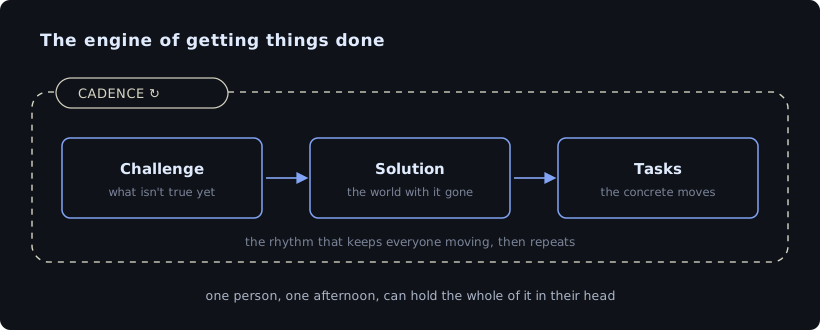
Challenge, solution, tasks, cadence. We've been refining that engine since Adam Smith watched a pin factory in 1776 and realised that splitting work into specialised tasks multiplied what a group could produce. It was one of the most powerful ideas in history. One person, one afternoon, can still hold the whole of it in their head.
But we don't get one thing done. We get thousands of things done, all at once, all tangled together. Your task is my blocker. My deadline is her cadence. His solution becomes your next challenge.
And here is where something quietly turns. Because every task you split off has to be rejoined later, and the cost of rejoining doesn't grow politely. It grows by a formula.
Connect n people and you create lines of coordination between them. Five people: ten connections. Fifteen people: a hundred and five. Fifty people: one thousand two hundred and twenty-five. Your output grows in a straight line as you add people. The cost of keeping them coordinated grows as a curve, bending up and away, until a company spends more energy staying aligned than doing the work it aligned around. Fred Brooks named the painful version of this in 1975: adding people to a late project makes it later.
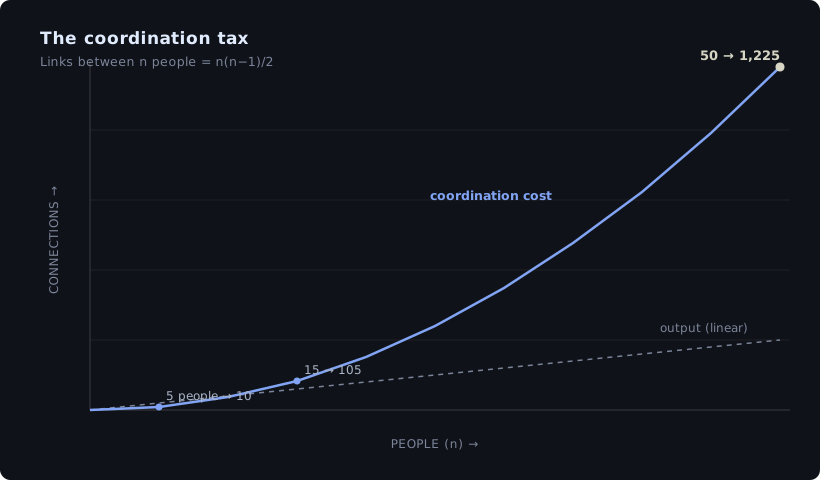
That curve has a name when it gets big enough. We call it a system.
Not in the cold, technical sense. A living one. A network of nodes, people, each with their own intentions, their own experience, their own plans, their own limitations. And a system like that has a will of its own. Its behaviour comes from the interactions, not the people. As Russell Ackoff put it, a system is never the sum of its parts; it's the product of their interactions. You can fill it with brilliant, dedicated people and still get a slow, defensive, mediocre result, because the structure produces the result, not the people.
And here is the thing almost nobody notices: we never designed that system. It grew. It accreted, one reasonable decision at a time, around a single old constraint: that human attention was the scarcest thing in the building, and getting people to coordinate was slow and expensive. Every layer, every handoff, every four-day approval is a fossil of that constraint.
That constraint just disappeared. And almost everyone is responding to its disappearance in exactly the wrong way.
The wrong question
Not how do we get things done, but how do we reframe the art of getting things done?
Almost everyone answers it the same wrong way. They take the system they already have and try to make it go faster. Same boxes, same handoffs, same cadence, just with AI bolted on to speed up each step.
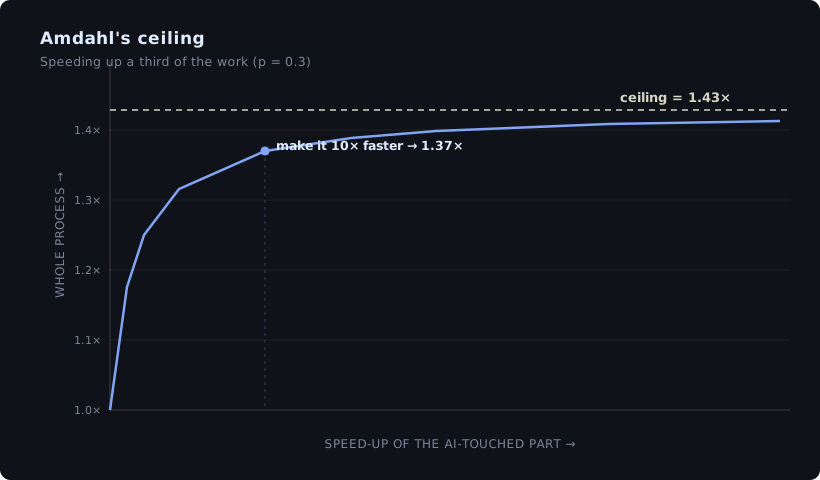
There is a law that tells you precisely how that ends. It's called Amdahl's Law, and it governs anything you try to speed up in parts.
Suppose AI makes a third of your work ten times faster. A third, ten times faster. That sounds enormous. Run the number and your whole process gets 37% faster. Now make that same third not ten times faster but infinitely fast, instant, free. The whole still speeds up by only 1.43×. You can never get past it, because the other two-thirds (the structure, the handoffs, the waiting) was built for the old way, and it doesn't care how fast the new part runs.
History already ran this experiment. When factories first got electricity around 1890, almost nothing happened. For nearly forty years, productivity barely moved. The owners did exactly what we're doing now: they tore out the giant steam engine, dropped in one giant electric motor, and ran the same belts and shafts off it. New power. Old shape. No gain. In 1987, the economist Robert Solow looked at the early computers and said the same thing in one line: "You can see the computer age everywhere but in the productivity statistics."
The explosion came only when someone asked a different question. Not "how do we power the old factory better?" but "what would a factory look like if it were built around this?" The answer was a small motor in every machine, and a floor laid out around the work itself instead of around the engine. That redesign didn't make the old factory faster. It made a new kind of factory possible.
Economists have a name for the shape of what follows: the productivity J-curve. A genuinely new technology makes things worse before it makes them better, because all the real work is invisible: rebuilding the organisation around the tool. The graveyard of failed AI projects you keep reading about isn't proof that AI doesn't work. It's the bottom of the J. It's the sound of a thousand companies bolting an electric motor to a steam-engine drive shaft and wondering why the numbers haven't moved.
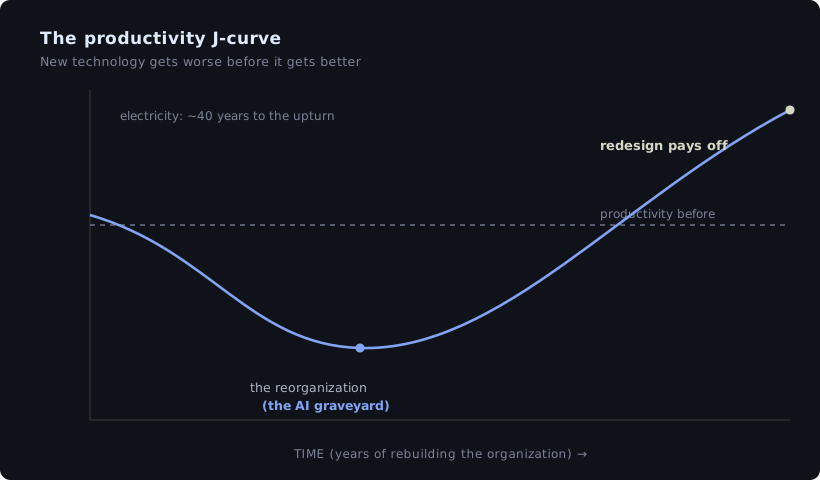
We are standing in that factory right now, holding the motor.
The point was never to do what we already do, faster. It's to change the structure we do it in.
So how
Stop asking AI to be a faster worker inside the old system. Start asking what the system would look like if it were designed around what AI now makes nearly free.
It means moving people up. Off the assembly line of tasks, and onto the things only a human can do: deciding what's worth doing, holding the taste, catching the exception, owning the judgment. The most reliable finding in the early data is that the new tools lift the novice far more than the expert; in one large study of customer support (Brynjolfsson, Li and Raymond, 2023) they raised output by 14% on average but 34% for the newest workers. Read that correctly and it isn't a story about productivity. It's a story about structure: about who gets to do what, and how flat the difference between green and seasoned becomes. The machine takes the getting-done. We take the deciding-what's-worth-doing.
It means building in loops instead of boxes. The old org was a set of departments, places where work sits and waits. The new one is a set of loops: sense what's happening, decide, act, and feel the result fast enough to go again. AI's real gift was never speed at a single task. It's that the loop that used to take a quarter can close in an afternoon.
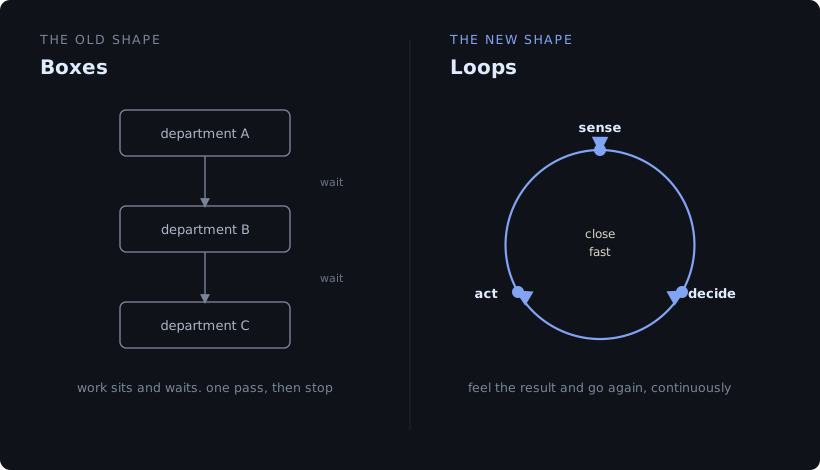
And it means resisting the laziest version of the idea, that this is about fewer people. It never was. There's even a warning in the data: a 2025 study by METR found experienced developers were actually 19% slower on code they knew well, while being convinced they were 20% faster. Drop a powerful tool into the wrong structure and it can quietly cost you while it feels like a gift. Fewer people in the same boxes is just a cheaper version of the thing that was already failing. The work is to change the boxes.
Starting fresh
And if you are not fixing an old company but starting a new one, this is the best moment in a generation to do it.
Because every incumbent has to fight the coordination curve it already built. You get to never pay it. That tax, the 1,225 connections, the meetings about meetings, is something you can simply decline. You don't manage a hundred people and their five thousand connections. You keep a tiny human core at the points of real judgment, and let fleets of agents carry the throughput that used to require the crowd.
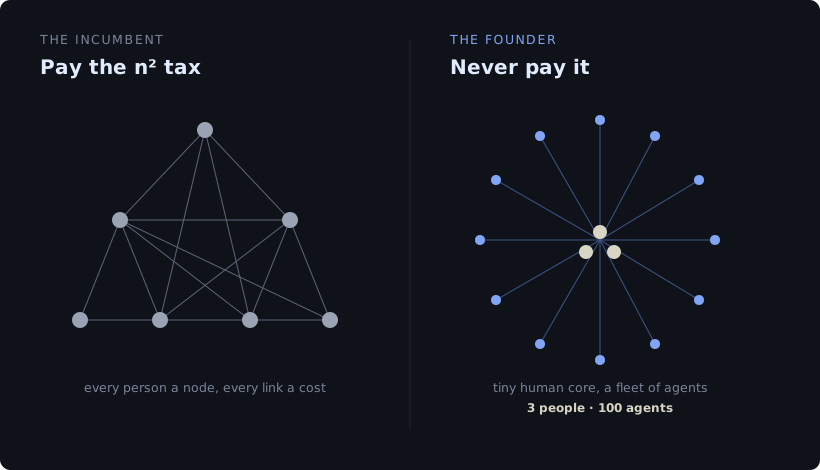
Which flips the founder's first job. Your first build isn't the product. It's the system that builds the product, because, as Melvin Conway observed sixty years ago, whatever you ship comes out shaped like the organisation that shipped it. Design the old shape, and you'll ship the old thing with a chatbot stapled to the front. Design a new shape, and you ship something that was never possible before.
Even the money changes shape. Software sold by the seat stops making sense when the work no longer needs more seats, which is why the new companies are pricing by outcome instead. The old playbook bends, the same way the old org chart bends, around a constraint that is no longer there.
We have spent two hundred and fifty years getting very, very good at getting things done.
The opportunity now is to get good at something harder, and far more worth it: redesigning how anything gets done at all.